
School Budget Template: What Should a School Budget Include?
A practical breakdown of what belongs in a school or university budget - and why getting the categories right matters more than the format.
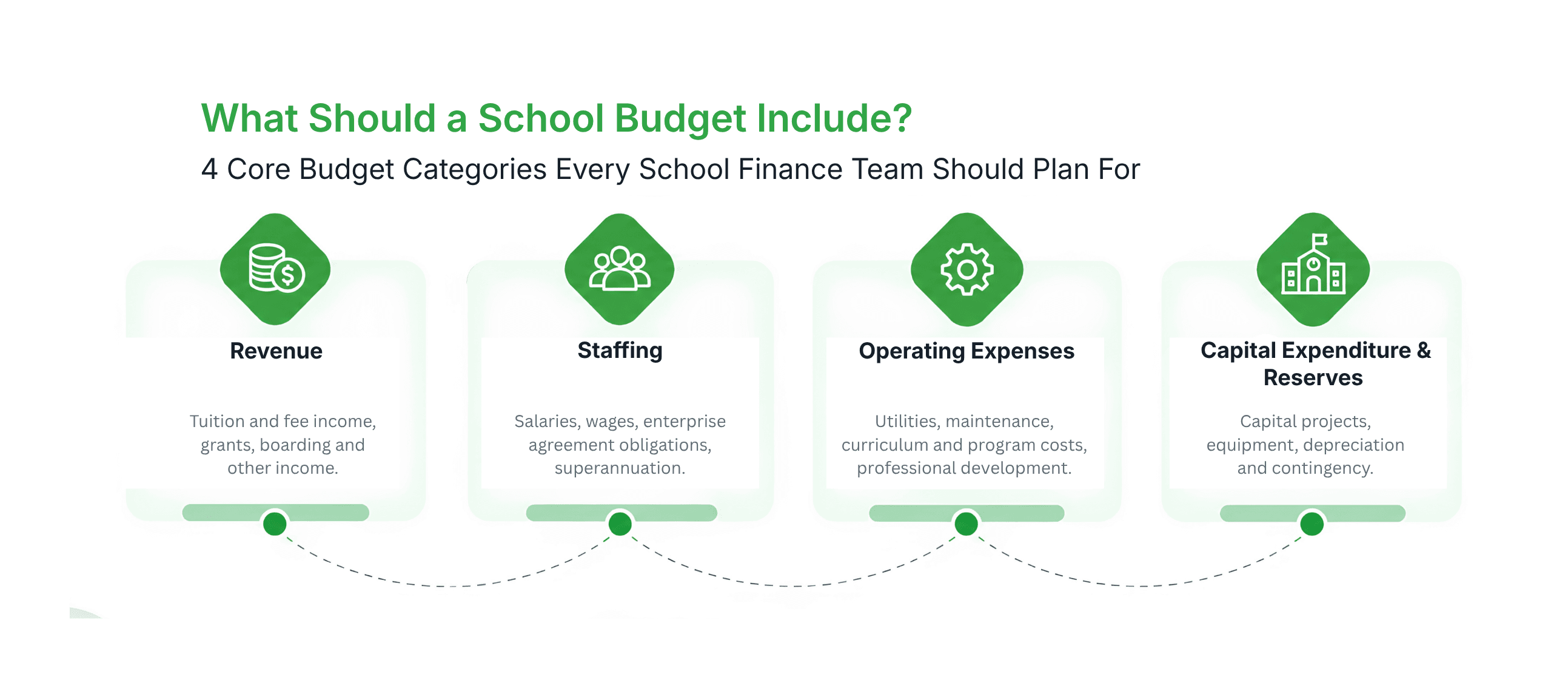
A school budget should typically include four core areas: revenue, staffing, operating expenses, and capital expenditure and reserves. Revenue can include tuition and fees, grants and other income; staffing includes salaries and related employment costs; operating expenses cover areas such as utilities, maintenance and programmes; and capital expenditure covers major assets, projects and related reserves.
KEY TAKEAWAYS
✅A school budget is built around revenue, staffing, operating costs, and capital/reserves - not around whoever happens to submit a template first.
✅The template matters less than whether every department is working from the same categories and assumptions.
✅Gaps at approval are usually a structural issue - missing or inconsistent categories - not a discipline issue. It's the week before budget templates go out, and the business manager is staring at last year's spreadsheet, deciding what to keep, what to rename, and what to add for a department that didn't have its own line last time. Marketing wants a new category for digital advertising. Boarding wants catering split out from general operations. The template that goes to twenty contributors this year won't quite match the one that came back last year - and everyone will feel that gap in March.
None of this happens because anyone is careless. It happens because a school budget template is rarely built once and then simply reused - it's rebuilt, category by category, under time pressure, by whoever is closest to the spreadsheet that week.
What Should a School Budget Include?
At minimum, a school or university budget should cover four groups of line items, each of which behaves differently and needs its own assumptions:
•Revenue — tuition and fee income by year level or cohort, government or state grants, boarding fees, and other income such as facility hire or canteen takings.
•Staffing — salaries and wages, enterprise agreement increases, casual and relief staffing, and superannuation. This is usually the largest single group and the one most sensitive to a single changed assumption.
•Operating expenses — utilities, maintenance, curriculum and program costs, professional development, and technology licences.
•Capital and reserves — capital expenditure projects, depreciation, asset replacement, and a contingency or reserve allocation.
Every school budget, regardless of size, needs a version of these four groups. What differs is the level of detail underneath them.
Why Do School Budgets Need Their Own Categories?
A generic business budget template doesn't map cleanly onto how a school actually spends and earns money. Fee income needs to be broken down by year level or fee category, not just "revenue." Staffing costs need to reflect enterprise agreements and boarding staff rosters, not a flat headcount line. Grants and bursaries need their own visibility because they're tied to conditions a general ledger won't capture on its own.
This is why importing a standard corporate budget structure often creates more translation work than it saves. The categories that matter to a school — enrolments, cohorts, fee categories, boarding, bursaries, enterprise agreements — are specific enough that a generic template usually needs to be rebuilt around them anyway
How Should the Categories Break Down?
| Category | What it Covers |
|---|---|
| Revenue | Tuition and fee income by year level or cohort, government or state grants, boarding fees, and other income (facility hire, canteen, events). |
| Staffing | Salaries and wages, enterprise agreement increases, casual and relief staffing, superannuation |
| Operating Expenses | Utilities, maintenance, curriculum and program costs, professional development, technology licences and subscriptions. |
| Capital & Facilities | Capital expenditure projects, depreciation, asset replacement and major maintenance. |
| Contingency & Reserves | Unallocated buffer for in-year changes, and planned contributions to reserve funds |
What Makes a Template Actually Useful for Contributors?
A budget template is only as useful as the consistency it enforces. If every department head receives the same categories, in the same format, with the same assumptions visible alongside the numbers, consolidation is mostly mechanical. If categories drift — a department adds a line, another renames one, a third submits totals with no breakdown — the finance team ends up reconciling structure before it can reconcile numbers.
None of this reflects a lack of discipline from contributors. A department head who returns their numbers on time, in the format they were given, is doing their job correctly. The friction shows up later, when finance has to combine submissions that were never quite asking for the same thing.
Now Imagine the Version That Works
Imagine every contributor working from the same categories from the start — not because they were told to follow a naming convention, but because there's only one template, one set of assumptions, and one place to enter a number. Finance isn't reconciling five versions of "operating expenses" before it can even start checking the numbers. The categories that matter to a school — enrolments, fee types, staffing, boarding — are already built in, not rebuilt every year from a blank sheet.
That's part of what PULSE is built for: a planning, budgeting, forecasting and reporting platform where the categories a school actually needs are already there, and every contributor works inside the same model instead of a separate copy of it. Existing workbooks and finance systems stay in place — the template becomes a shared structure, not one more file to track down.
Frequently Asked Questions
Revenue, staffing, operating expenses, and capital and reserves. Most schools break these down further into fee categories, departmental costs, and specific capital projects, but these four groups form the base structure.
Get Every Category Covered Before You Build
Download the free School Budget Template - pre-built with the categories schools and universities actually use, ready to adapt in Excel or Google Sheets.