
School Budget vs Forecast: What's the Difference and When Should You Use Each?
A clear breakdown of what each document is for, how they differ in timing and inputs, and when schools should use one, the other, or both.
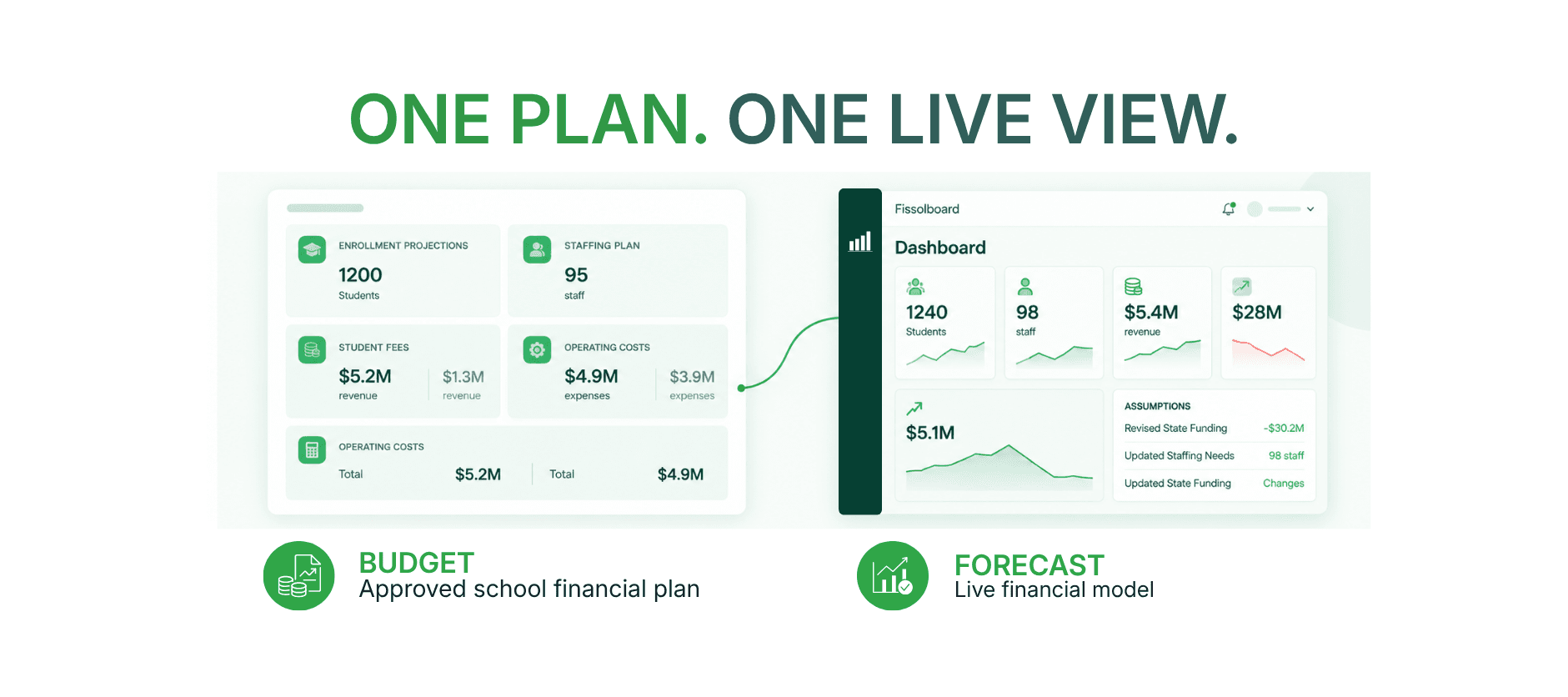
A school budget is the approved financial plan set before the year begins, built from enrolment, fee and staffing assumptions and signed off by the Board. A forecast — or reforecast — updates that plan during the year using real enrolment, staffing and cost data as it arrives, without necessarily requiring the same approval cycle. Schools use the budget to set direction for the year and the forecast to track and adjust against it as the year unfolds.
Key Takeaways
- A budget is fixed once the Board approves it; a forecast is a living update made as real data replaces assumptions.
- The underlying inputs are largely the same — enrolment, fees, staffing, operating costs. The difference is timing and purpose, not the numbers themselves.
- Most schools reforecast once or twice a year, commonly after census-date enrolments land.
It's a Tuesday in March, and a Board member asks why the operating result looks different from the budget that was approved in November. Enrolment came in lower than planned. Two staffing vacancies were filled later than expected. A grant arrived earlier than the budget assumed. The business manager isn't explaining a budget overrun — they're walking the Board through a reforecast, a separate document built around what's actually happened so far this year.
The confusion is common, and it isn't really about financial literacy. "Budget" and "forecast" get used interchangeably in everyday conversation even though they're two distinct tools answering two different questions.
What Is the Difference Between a School Budget and a Forecast?
A budget is the plan. It's built once, before the year starts, from the best available assumptions at that point in time, and it sets the spending authority the school operates against. A forecast is the update. It's built during the year, using confirmed actuals wherever they exist and revised assumptions for whatever's left, to answer a different question: given what we now know, where will we actually land?
| Budget | Forecast | |
|---|---|---|
| Purpose | Sets the plan and spending authority for the year ahead. | Tracks the year against that plan as actuals come in. |
| Timing | Built once, before the year starts. | Updated periodically during the year — commonly once or twice. |
| Inputs | Enrolment, fee and staffing assumptions at a single point in time. | Confirmed actuals to date, plus updated assumptions for the remainder of the year. |
| Approval | Requires Board approval before the year begins. | Typically reviewed by finance and the Executive; may not need full Board re-approval. |
| Audience | Board, Executive, and external stakeholders. | Finance and Executive, often summarised for the Board. |
Why Do Schools Need Both?
A budget that turns out to be wrong by March hasn't failed — it was built from the best information available in November, and enrolment, staffing and costs were always going to move by some margin. The budget's job isn't to predict the year perfectly. It's to set direction, give departments spending authority, and give the Board a document to hold the school accountable against.
The forecast's job is different: to keep that accountability honest as reality diverges from the plan. Without a forecast, a school either keeps reporting against an increasingly outdated budget, or rebuilds the entire model from scratch every time something changes — neither of which is necessary when the forecast exists specifically to do that updating work.
When Should a School Reforecast?
- After census-date enrolments land — the single most common trigger — actual enrolments replace the assumption the budget was built on.
- After a material wage settlement or EA outcome — when the agreed increase differs from what the budget assumed.
- After an unplanned capital event or grant change — a delayed project, an unexpected repair, or a grant that lands outside its assumed timing.
- On a fixed cadence — many schools build reforecasting into the calendar — commonly mid-year — regardless of whether a specific trigger has occurred.
Now Imagine the Version That Works
Imagine the forecast isn't a separate document rebuilt from the budget each time, but the same model carried forward — the enrolment, staffing and revenue assumptions that built the original budget are still there, and reforecasting means updating what's changed rather than reconstructing the whole thing. The Board sees a direct line from the approved budget to the current forecast, not two documents that have to be reconciled by hand.
That's part of what PULSE is built for: a planning, budgeting, forecasting and reporting platform where the model used for the annual budget becomes the model used for the next forecast, rather than starting again. Existing workbooks and finance systems stay in place — PULSE keeps the budget and the forecast connected, so updating one assumption doesn't mean rebuilding a second spreadsheet to match.
Frequently Asked Questions
Yes, in most schools' usage. "Reforecast" specifically describes updating an existing budget during the year; "forecast" is sometimes used more broadly, but in school finance the two terms are generally interchangeable.
See Your Budget and Forecast Side by Side
Download the School Budget vs Forecast One-Page Guide + Comparison Checklist — a quick reference for finance teams and a checklist for knowing when it's time to reforecast.