← Back to Blog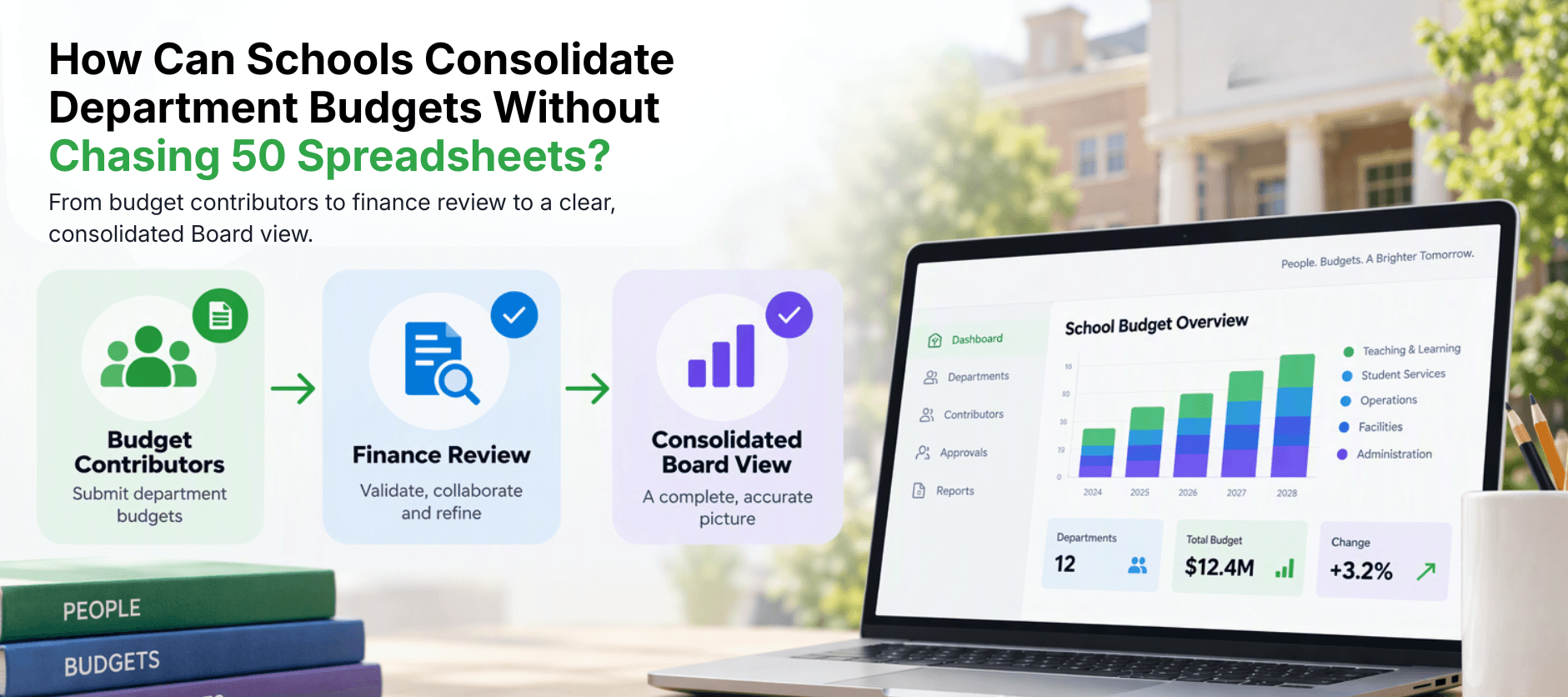
School Budgeting
How Can Schools Consolidate Department Budgets Without Chasing 50 Spreadsheets?
A practical look at how school budget consolidation can run from budget contributors to finance review to the Board view, with clear roles and handoffs at each step.
October 12, 2026
Quick Answer
A school can consolidate department budgets more efficiently by giving every budget contributor the same structure, collecting numbers in one place instead of by email, reviewing each submission as it arrives, and building the Board view from the same data. The time saving comes from removing the handling work (chasing, checking and re-keying), not from asking contributors to work faster. In school budget consolidation, a clear workflow with defined roles and handoffs matters more than any single tool.
Key Takeaways
- Most of the time in school budget consolidation goes into handling files, not reviewing numbers.
- One structure, clear owners and a defined handoff at each stage prevent most of the rework.
- Collect once, review as submissions arrive, and build the Board view from the same data.
It's two weeks before the Board pack is due. The business manager has a tracking sheet with 47 rows, and 31 templates are back. Six came back as PDFs. Two have an extra column. One head of department has sent a revised version of a version she already sent, and nobody is quite sure which one the master was built from.
None of this reflects a lack of care. Every one of those department heads is busy running a department, and the numbers they sent are probably right. The work is in turning 47 separate answers into one consistent budget, and that is the part this guide is about.
How Can a School Consolidate Department Budgets More Efficiently?
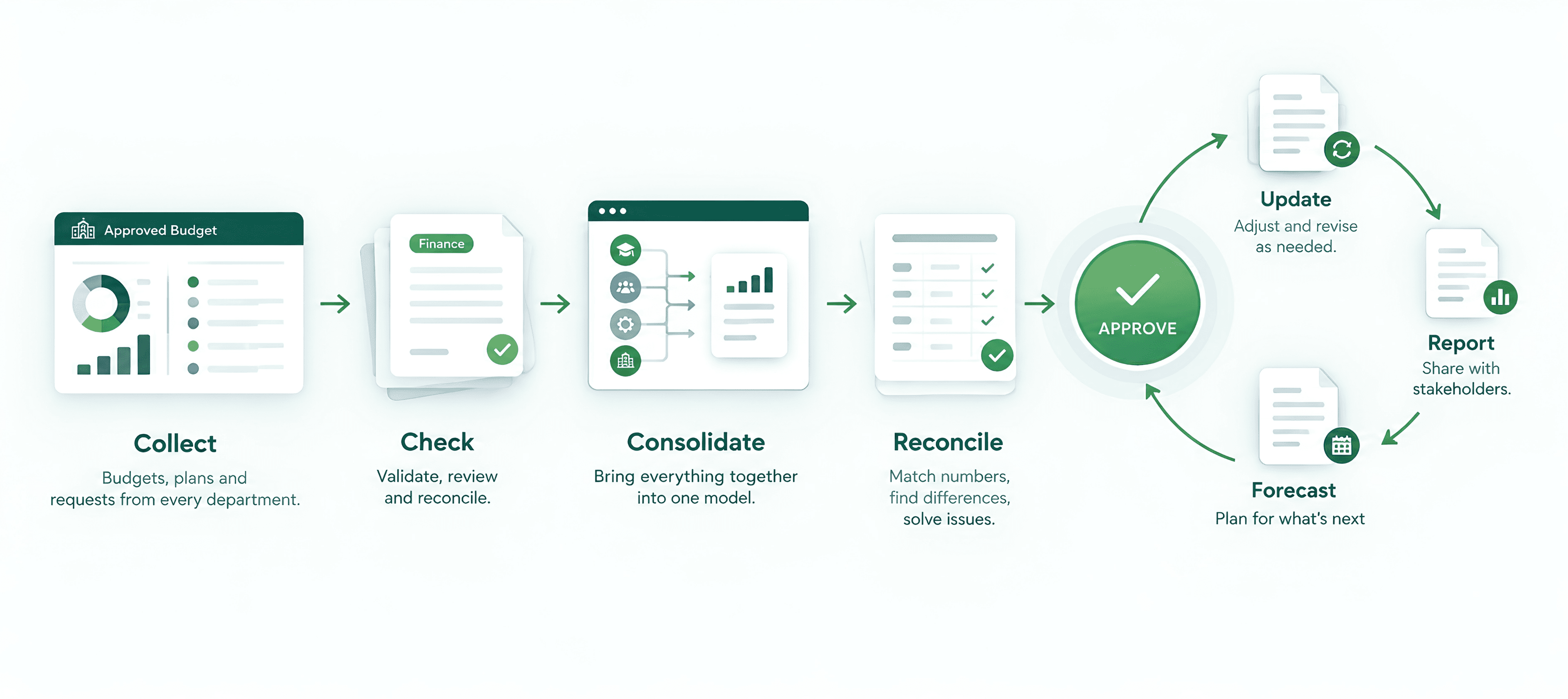
The most reliable way is to treat consolidation as a workflow with clear stages, not as a task that begins when the last file comes back. Most schools that run it smoothly follow a version of these seven steps:
- Set the structure once: one template, the same categories for every department, and the assumptions visible alongside the numbers.
- Brief the budget contributors: what is needed, by when, and who to ask if something is unclear.
- Collect in one place: every contributor submits to the same location instead of a separate email thread.
- Review as numbers arrive: finance checks each submission when it lands, rather than waiting for all of them.
- Resolve queries with the contributor: questions and answers stay attached to the numbers they relate to.
- Consolidate into one model: approved submissions are combined without re-keying.
- Build the Board view from the same data: the Board pack comes from the consolidated model, not a separate workbook.
Who Does What, and What Gets Handed Over?
Clear roles are what stop a collection process from turning into a chase. Each stage has one owner and one thing that moves to the next stage:
| Stage | Who Owns It | What Gets Handed Over |
|---|---|---|
| Brief and template | Finance team | The template, current assumptions and a deadline, sent to each budget contributor. |
| Contribution | Budget contributor | Completed figures for the department, with a short note on anything that has changed. |
| Finance review | Finance team | Either an approved submission or a specific question back to the contributor. |
| Consolidation | Finance team | One combined model that the Executive can review. |
| Executive review | Business manager and Executive | An agreed budget, with any final adjustments recorded. |
| Board view | Business manager | A Board pack built from the same consolidated data. |
Where Does the Time Go in School Budget Consolidation?
Very little of the calendar goes into the decisions that matter, like whether a department needs another staff member or what a fee increase should be. Most of it goes into the mechanics: sending templates, tracking who has replied, opening each returned file, checking that the formulas survived, and combining the numbers into the master.
Then the corrections arrive. A department head remembers a cost that was left out. An assumption changes. The master gets updated, and sometimes the Board pack has to be updated again to match.
Why Is Collecting Budgets From Department Heads So Hard?
Because budget contributors are experts in their own departments, not in finance. They are filling in a template on their own schedule, usually between other jobs, and each one reads the instructions a little differently. That is a normal outcome of asking many people to contribute to one document, and it happens in well-run schools every year.
There is also a reason email became the default. It works, everyone has it, and it needs nothing new from anyone. Budget collection by email only starts to strain when the number of contributors grows and every returned file has to be checked and combined by hand.
What Makes a Good Budget Collection Process?
You don't need new software to improve how department budgets are collected. These changes help in almost any process, and they are the thinking behind the collection template and contributor checklist at the end of this post:
- Use one template for every department: so every return has the same layout and the same categories.
- Pre-fill what finance already knows: prior year actuals, the current budget and the assumptions contributors should use.
- Give a plain deadline and one contact: so contributors know when to return it and who to ask.
- Ask for a short note on big changes: so finance doesn't have to chase the reason later.
- Track status in one place: so you can see at a glance who has returned, who is under review and who is still outstanding.
Now Imagine the Version That Works
Imagine every contributor opening their own view in a browser, seeing the figures and assumptions that matter to their department, entering their number and leaving the explanation beside it. There is no file to check, no version to reconcile and no re-keying between submitted and consolidated.
Finance can see who has submitted and who hasn't without opening an attachment, and reviews each submission as it arrives. When the last department is approved, the consolidated budget already exists, and the Board view comes from the same data.
That's what PULSE is built to do: a planning, budgeting, forecasting and reporting platform built for schools, where contributors work inside one connected model and finance spends its time reviewing numbers rather than assembling them. It works around the data a school already has. The finance system stays in place, existing workbooks can be the starting point, and finance keeps control of what gets approved.
If you're comparing school budgeting software for budget collection, a useful question to ask is whether contributors can work in one shared place without finance having to rebuild the model they already trust.
Frequently Asked Questions
It depends on the number of contributors and the quality of the returns, but a realistic goal is for consolidation to finish within days of the last submission. That is possible when review has happened along the way instead of all at once at the end.
Related Articles
- School BudgetingSchool Budgeting in Excel: What Works, What Gets Difficult, and When to Change?
- School BudgetingHow Do You Build a School Budget? A Step-by-Step Guide for Finance Teams
- School BudgetingSchool Budget vs Forecast: What's the Difference and When Should You Use Each?
- School BudgetingSchool Budget Template: What Should a School Budget Include?
- PlanningWhy Is the School or University Budget Never Actually Finished by the Time It's Approved?