← Back to Blog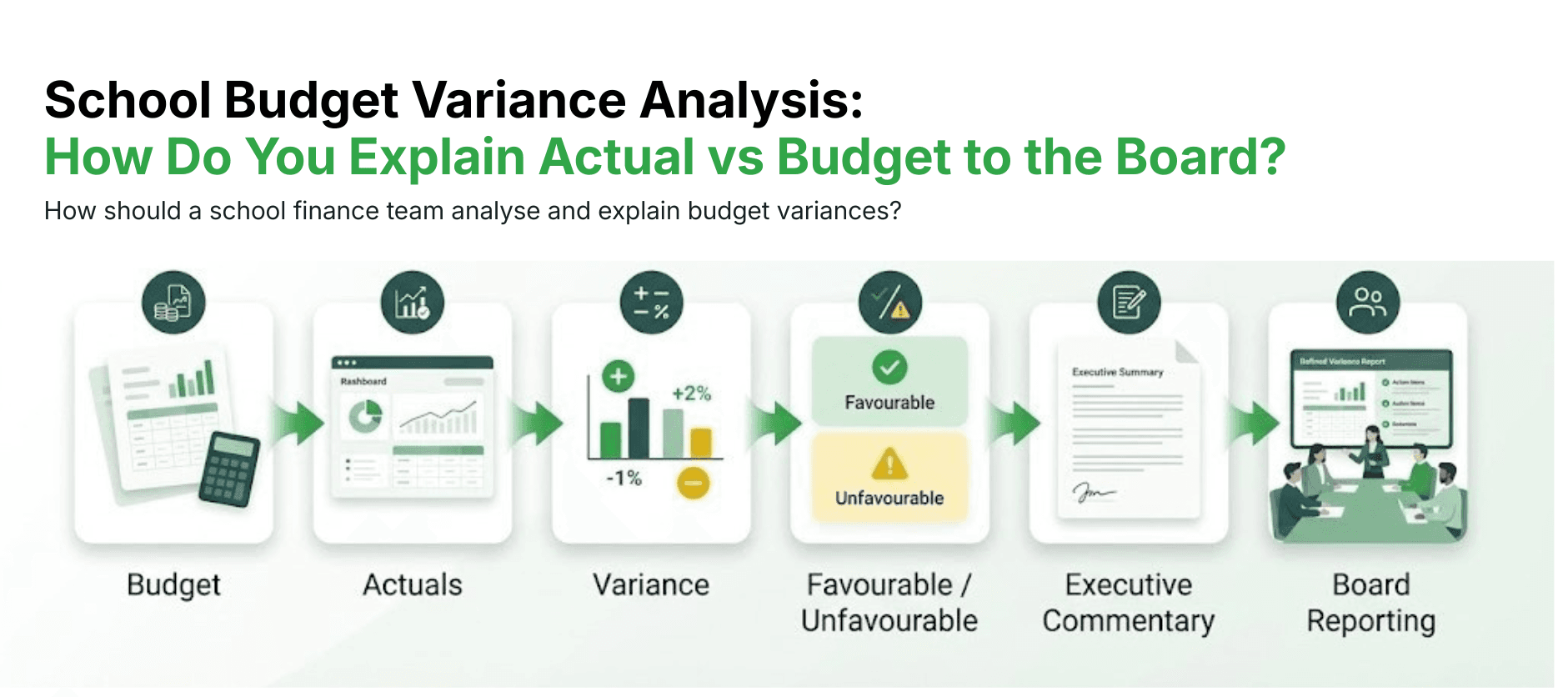
School Budgeting
School Budget Variance Analysis: How Do You Explain Actual vs Budget to the Board?
A plain guide to analysing budget variances, deciding which ones matter, and writing commentary that Executive and Board members can act on.
October 14, 2026
Quick Answer
School budget variance analysis compares actual results with the approved budget, calculates the difference for each line, and explains the differences that matter. A variance is favourable when it improves the result (more income than budgeted or a lower cost) and unfavourable when it reduces it. A finance team should focus on material variances and say what caused each one, whether it is a timing difference or a lasting change, and what it means for the full year. Board members usually want the story behind the number more than the number itself.
Key Takeaways
- A variance is the difference between actual and budget. Favourable or unfavourable describes the effect on the result, not whether something went well or badly.
- Spend the explanation on the few variances that are material, not on every line.
- Good Board commentary says what happened, why, whether it will continue, and what happens next.
A Board member points at a line on page four. Professional development is up 11%, and she would like to know why. The business manager knows the answer: a new teaching programme was approved in term two, and part of the cost was offset by lower casual relief. But the detail lives in an email from March and a conversation in the staffroom, and for a moment the room waits while it gets pieced together.
That moment is the real subject of school budget variance analysis. The numbers are usually right. The challenge is having the explanation as ready as the figure, so the answer doesn't depend on somebody remembering what changed three months earlier.
What Is School Budget Variance Analysis?
School budget variance analysis is the process of comparing actual results with the approved budget for a period, working out the difference on each line, and explaining why the difference arose. You may also hear it called budget vs actual analysis. The calculation is simple: the variance is the actual figure minus the budget figure, and the percentage variance is that difference divided by the budget.
The skill is in what comes after the calculation. A table of variances tells the Board what moved. Variance analysis tells them why it moved and whether it matters.
What Is the Difference Between a Favourable and an Unfavourable Variance?
A favourable variance improves the school's result compared with the budget. Income that comes in above budget is favourable, and so is a cost that comes in below budget. An unfavourable variance does the opposite: income below budget, or a cost above it. Here is what that looks like in practice:
| Line | Budget | Actual | Variance | Reading |
|---|---|---|---|---|
| Tuition and fee income | 4,900,000 | 4,820,000 | -80,000 (-1.6%) | Unfavourable: fewer enrolments than planned in two year levels. |
| Salaries and wages | 3,100,000 | 3,040,000 | -60,000 (-1.9%) | Favourable: two vacancies were filled later than planned. |
| Professional development | 90,000 | 99,900 | +9,900 (+11.0%) | Unfavourable: a new teaching programme started mid-year. |
| Utilities | 210,000 | 198,000 | -12,000 (-5.7%) | Favourable: lower usage than budgeted. |
| Grants | 350,000 | 380,000 | +30,000 (+8.6%) | Favourable: a grant arrived earlier than assumed. |
Favourable doesn't always mean good news. A salary saving from vacancies might mean a team is stretched, and an income gain from an early grant may simply be timing that reverses later. This is why the explanation matters as much as the label.
Which Variances Deserve an Explanation?
Not every line needs a paragraph. Most finance teams agree a materiality threshold in advance, usually a minimum amount and a minimum percentage, so that small movements are noted in the report but not discussed. The exact thresholds are a decision for each school and its Board. Once a variance passes the threshold, these questions help decide how much to say:
- Is it timing or permanent: a payment that arrived early will correct itself, while a lower enrolment will not.
- Is it a one-off or will it recur: a one-off repair is different from a cost that will continue all year.
- Does it change the full-year outlook: a variance that will carry through to year end belongs in the forecast.
- Does it touch something the Board watches closely: enrolments, fees and staffing usually get more attention than small operating lines.
What Should the Commentary for the Executive and Board Say?
Strong commentary follows a simple pattern: what happened, why it happened, whether it will continue, and what it means for the rest of the year. Compare these two versions of the same variance.
Version one: Professional development is over budget due to additional spend.
Version two: Professional development is 9,900 (11.0%) over budget year to date. The increase reflects a new teaching programme approved in term two, which was not in the original budget. Part of the cost is offset by lower casual relief spending. The programme will continue through the year, and the full-year forecast has been updated to include it.
Version one is accurate, but it invites a follow-up question. Version two answers the follow-up before it is asked. The Executive and the Board need different levels of detail from the same analysis:
| Audience | What They Usually Need |
|---|---|
| Executive | More lines, the operational cause of each variance, who owns the follow-up action, and how it affects next month. |
| Board | The headline result, only the material variances in plain language, the full-year outlook, and any decision that is needed. |
Why Does Variance Analysis Take So Long?
In many schools it takes longer than it should for understandable reasons. Actuals come out of the finance system, the budget sits in a separate workbook, and the report is built by hand to bring them together. Explanations are collected by email from budget holders after the variances are already known. And by the time the Board pack is due, the reason behind a number may have to be rebuilt from memory.
None of this reflects a lack of skill. The finance team is usually doing careful work with the tools in front of them. The strain comes from the structure: budget, actuals and explanations live in different places, so the work of connecting them repeats every month.
What Habits Make Variance Analysis Easier?
You can improve the process without changing any tools. These habits make a visible difference, and they are the thinking behind the template and commentary guide at the end of this post:
- Agree the materiality threshold in advance: so everyone knows which variances need an explanation.
- Record the reason when a number changes: a short note at the time is worth far more than a reconstruction later.
- Ask budget holders for one line each period: a single sentence on any large movement in their area.
- Separate timing from permanent changes: so the full-year outlook reflects what will really happen.
- Update the forecast when a variance is ongoing: so next month's report starts from the right place.
Now Imagine the Version That Works
Imagine budget and actuals sitting side by side in one place, with the variances calculated as soon as the actuals arrive. When a number moves, the budget holder leaves a one-line reason beside it, and that note stays with the number from then on. The commentary for the Executive starts from a draft that already exists, and the Board pack comes from the same data.
When a Board member asks why professional development is up 11%, the explanation is already there. That's what PULSE is built to help with: a planning, budgeting, forecasting and reporting platform built for schools, where budget, actuals and commentary are connected. It works alongside the school's finance system, which remains the source of the actuals, and existing reports can be the starting point rather than something to rebuild.
The aim isn't to replace the judgement in good commentary. It's to give the finance team more time for the part that needs judgement, and less time for the part that is assembling.
Frequently Asked Questions
A budget variance is the difference between the actual result and the budgeted figure for a line or a period. It can be shown as an amount, a percentage, or both.
Related Articles
- School BudgetingHow Can Schools Consolidate Department Budgets Without Chasing 50 Spreadsheets?
- School BudgetingSchool Budgeting in Excel: What Works, What Gets Difficult, and When to Change?

- School BudgetingHow Do You Build a School Budget? A Step-by-Step Guide for Finance Teams

- School BudgetingSchool Budget vs Forecast: What's the Difference and When Should You Use Each?
- School BudgetingSchool Budget Template: What Should a School Budget Include?
- PlanningWhy Is the School or University Budget Never Actually Finished by the Time It's Approved?