School Budgeting
What Should Be in a School Board Financial Report? 7 Reports Finance Teams Should Track
A clear list of the seven reports a school Board should receive, what each one tells them, and how to keep the pack short enough to be read.
October 16, 2026
Quick Answer
A school Board should receive a regular finance pack built around seven reports: budget vs actual, a full-year forecast, cash flow, revenue and enrolments, receivables, the balance sheet, and a short set of KPIs. Together they show how the school is performing against plan, where it expects to finish, whether it can meet its commitments, whether income is on track, who owes the school money, what the school owns and owes, and whether the key measures are moving the right way. The goal of school Board financial reporting is clarity, not volume.
Key Takeaways
- A Board finance pack works best as a small set of reports that each answer one question.
- Budget vs actual and the forecast tell the story. Cash, receivables and the balance sheet show whether the school can keep going comfortably.
- A short pack, in the same order each period and built from the same data, is easier for a Board to read than a long one.
A new Board treasurer asks the business manager a fair question: what should a proper finance pack actually look like? The business manager opens the current one. It has grown over the years. A cash page was added after one tough year, a fee debtors page after another, and the KPI page after a Board member asked for it. Every page earned its place, and nobody has ever sat down and designed the whole thing.
That is how most school Board packs are built, and it is not a flaw. It does mean the question is worth answering from a blank page. If you were choosing from scratch, which reports would a Board need to govern well, and no more?
What Financial Reports Should a School Board Receive?
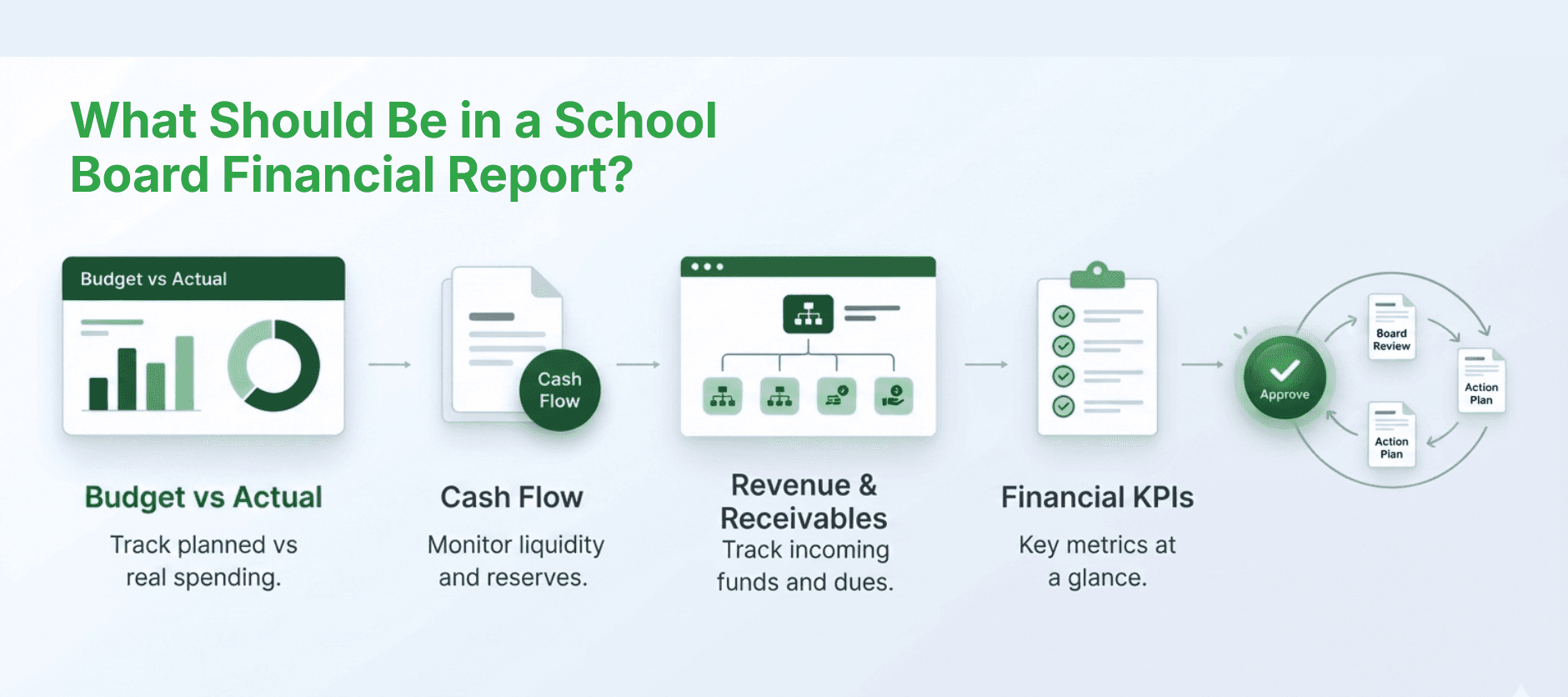
Most schools find that seven reports cover what a Board needs to see. Each one answers a different question:
- Budget vs actual: how the school is performing against the approved plan.
- Full-year forecast: where the school now expects to finish the year.
- Cash flow: whether the school can meet its commitments as they fall due.
- Revenue and enrolments: whether income is on track, and why.
- Receivables: who owes the school money and for how long.
- Balance sheet: what the school owns and owes.
- KPIs: whether a handful of key measures are moving in the right direction.
What Does Each Report Tell the Board?
| Report | The Question It Answers | What It Should Show |
|---|---|---|
| Budget vs actual | How are we doing against the plan? | Income and costs against budget, with variances as an amount and a percentage, and short commentary on the material ones. |
| Full-year forecast | Where do we expect to finish? | The updated expected result for the year, with the assumptions that have changed since the budget. |
| Cash flow | Can we meet our commitments? | The current cash position, the movement for the period, and expected cash needs over the coming months. |
| Revenue and enrolments | Is our income on track? | Enrolments against budget by year level, and fee income against budget, with reasons for any gap. |
| Receivables | Who owes us, and for how long? | Outstanding fees by age, the collection trend, and accounts that need attention. |
| Balance sheet | What do we own and owe? | A summary of assets and liabilities, with movement since the last report or year end. |
| KPIs | Are the key measures moving the right way? | A short, agreed set of indicators, each shown with a trend rather than a single figure. |
Why Do the Budget vs Actual and Forecast Reports Come First?
Because they tell the story the Board is there to oversee. Budget vs actual shows what has happened so far, and the forecast shows what that means for the year. Together they let a Board ask the questions that matter, like whether a variance will continue and whether the school still expects to meet its plan.
The other five reports give that story its context. Cash flow and the balance sheet show whether the school is financially comfortable, and revenue, receivables and KPIs show whether the main drivers are healthy.
Which KPIs Should a School Board Track?
There is no single right list, and the best Board packs keep it short. Common examples include enrolments against budget, the fee collection rate, staffing costs as a share of income, the operating result as a percentage of income, and cash held measured in days or months of costs. The right set is the one the Board agrees is useful for its school, shown with a trend so that direction is clear.
Why Does a Board Finance Pack Take So Long to Build?
Because the seven reports usually come from different places. Actuals come from the finance system, the budget and forecast sit in separate workbooks, receivables come from the fee ledger, and the commentary is written after all the numbers are in. The pack is then assembled by hand, month after month.
None of this reflects a lack of skill. Business managers and finance teams often produce excellent packs with the tools they have. The strain comes from rebuilding the same pack from scratch each period, and from checking that the pages agree with each other before they go out.
How Can You Make the Pack Easier for the Board to Read?
These habits help whatever tools you use, and they are the thinking behind the checklist at the end of this post:
- Start with a one-page summary: the headline result, the forecast and anything the Board needs to decide.
- Keep the same order every period: so Board members know where to look.
- Put commentary beside the numbers: not in a separate document that has to be read alongside.
- Show trend, not only the current month: direction is often more useful than a single figure.
- Agree the contents with the Board each year: so the pack changes on purpose, not by accumulation.
Now Imagine the Version That Works
Imagine the seven reports all drawing from the same data. Actuals come from the finance system, the budget and forecast come from the same model, and receivables line up with the same ledger. When a new period closes, the pack refreshes instead of being rebuilt, and the pages already agree with each other.
The commentary sits beside the numbers it explains, so when a Board member asks why a line moved, the answer is already on the page. That's what PULSE is built to support: a planning, budgeting, forecasting and reporting platform built for schools. It works alongside the school's finance system, which remains the source of the actuals, and an existing pack layout can be the starting point rather than something to redesign.
The finance team still decides what the Board sees and what to say about it. The difference is that more of the time goes into that judgement, and less into assembling the pages.
Frequently Asked Questions
A typical school Board finance pack includes budget vs actual, a full-year forecast, cash flow, revenue and enrolments, receivables, a balance sheet and a short set of KPIs. The exact pack depends on the school's size, governance and what the Board has agreed it needs.
Related Articles
- School BudgetingSchool Budget Variance Analysis: How Do You Explain Actual vs Budget to the Board?
- School BudgetingHow Can Schools Consolidate Department Budgets Without Chasing 50 Spreadsheets?
- School BudgetingSchool Budgeting in Excel: What Works, What Gets Difficult, and When to Change?
- School BudgetingHow Do You Build a School Budget? A Step-by-Step Guide for Finance Teams
- School BudgetingSchool Budget vs Forecast: What's the Difference and When Should You Use Each?
- School BudgetingSchool Budget Template: What Should a School Budget Include?
- PlanningWhy Is the School or University Budget Never Actually Finished by the Time It's Approved?